1. InfoQ #
- Grafana 13.3 Adds Shared Dashboard Variables and Notebooks

Grafana 13.3 introduces shared variables across dashboards and adds Notebooks to record investigations. Both features are in public preview and require feature toggles for self-managed installations.
By Mark Silvester Sat, 21 Nov 2026 14:30 GM 2026-11-21 14:30ZQCon San Francisco 2026: Scaling Tech by Aligning Humans
At QCon San Francisco 2026, Scott Behrens, Principal Security Engineer at Netflix, presented how staff-plus engineers can define and align a company-wide technical strategy.
By Daniel Dominguez Sat, 21 Nov 2026 13:30 GM 2026-11-21 13:30ZHow Google Traced GKE API Timeouts to a Linux Kernel TCP Bug

Google recently detailed how three interacting bugs across Google Kubernetes Engine (GKE), Private Service Connect, and the Linux kernel caused intermittent Kubernetes API connectivity failures, blocking around 800 developers from deploying to production.
By Renato Losio Sat, 21 Nov 2026 09:44 GM 2026-11-21 09:44ZMeta TLX, a Native GPU Compiler Extension Supporting Advanced Hardware Capabilities

Meta developed Triton Low-Level Extensions (TLX), designed to bridge the gap between high-level GPU programming abstractions and the low-level execution control required to fully exploit modern GPU architectures.
By Sergio De Simone Fri, 20 Nov 2026 18:00 GM 2026-11-20 18:00ZUber Cuts Translation Cache Memory by up to 90% While Keeping P99 Latency Below 1 MS

Uber redesigned its Go-based translation cache to reduce its initial memory footprint by more than 90% while maintaining a cache hit rate above 99.9% and p99 disk-backed cache miss latency below 100 microseconds. The hybrid architecture combines in-memory keys and frequently accessed values with disk-backed storage, reducing garbage-collection overhead and memory consumption.
By Leela Kumili Fri, 20 Nov 2026 14:38 GM 2026-11-20 14:38ZGoogle Donates Agent Substrate and gVisor to the CNCF to Secure AI Agents at Scale

Google has announced it is donating Agent Substrate and gVisor to the Cloud Native Computing Foundation (CNCF), placing two important components of its AI agent infrastructure under vendor-neutral open-source governance.
By Craig Risi Fri, 20 Nov 2026 12:00 GM 2026-11-20 12:00ZPresentation: Modernising Retail at Scale: Architecting a Cloud‑to‑Edge Platform for a Global Enterprise
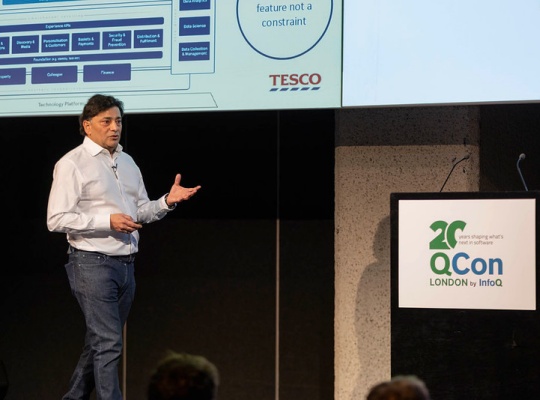
Jayesh Bhayani discusses Tesco’s decade-long enterprise transformation from fragmented legacy systems to a unified cloud-edge platform. He explains how aligning system, talent, and process modernizations allowed Tesco to scale mission-critical retail operations to millions of customers, while sharing practical lessons on build vs. buy, cloud cost management, and preparing for agentic commerce.
By Jayesh Bhayani Fri, 20 Nov 2026 11:00 GM 2026-11-20 11:00ZQCon San Francisco 2026: The Future of Apache Iceberg

Apache Iceberg V4 proposes a redesign of table metadata to improve scalability and support more frequent writes, alongside new capabilities for data management and schema evolution. Daniel Weeks, co-creator of Apache Iceberg and member of technical staff at Databricks, presented a session at QCon San Francisco on the fourth version of the Apache Iceberg open table format specification.
By Renato Losio Fri, 20 Nov 2026 09:17 GM 2026-11-20 09:17ZArticle: Building Reliability Into the Cloud: Observability as the Control Plane for Multi-Region Failover

Cloud SLAs promise uptime statistically, not absolutely. This article shows how to treat observability as a control plane that detects regional degradation, triggers automated failover, and confirms recovery rather than paging a human. Covers active-active architecture, DNS TTL pitfalls, composite Prometheus alerting, Route 53 weighted routing, and confirmation loops backed by a real S3 outage.
By Saurabh Ahuja Fri, 20 Nov 2026 09:00 GM 2026-11-20 09:00ZAWS Releases a Free Local Emulator of AWS Built Entirely by Agents

AWS has released AWS Emulator, a free, CC0-licensed local stand-in for more than 200 of its services, generated from its public API models and aimed at the test loops of coding agents. AWS says agents wrote and maintain all of the code and publishes per-release fidelity scores. The docs say it does not evaluate IAM, and practitioners are split on trusting an emulator nobody reviewed.
By Steef-Jan Wiggers Fri, 20 Nov 2026 06:53 GM 2026-11-20 06:53Z